Showing posts with label Dals / Saaru. Show all posts

Sep 8, 2011

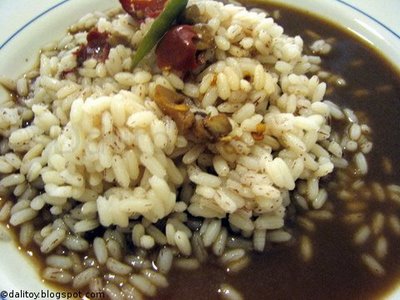
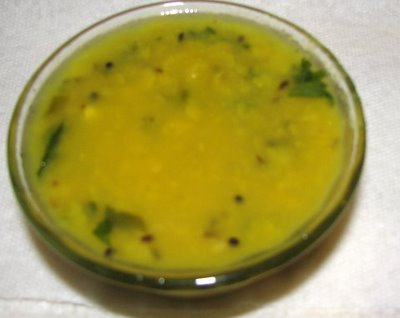
Tomato Saaru / Devatsana Saaru/ Spicy Tomato Soup


I grew up in the small town of Puttur which was a quite town back then. Most of the socializing was during a temple festival or events/utsav's which is usually followed by a delicious finger licking meal for everyone who visited the festivities. These meals are often called boori samaradhane in Konkani which means meals for everyone. Back then I did not find these meals exciting, simply because there were too many of them and often. Waiting long hours for the meals to be served, on a hungry stomach wasn't very exciting. But when the meals are served on a banana leaves and the aroma of the saaru, dalitoy, gashi, pickles noNche filled the lunch rooms ..ah it was worth the the wait. It is a memory to be cherished.

Mar 22, 2011

Molavees


"moLavees" Yes, it is a Konkani dish. Probably one of the recipes, in the verge of extinction. When my mother-in-law mentioned it, I wasn't sure she was talking about a Konkani dish. We were talking about the dishes from our childhood, and she happened to recollect this dish. My MIL's mother was from Kerala and this must have been a dish with Keralite influence.

Oct 26, 2007

Alle Dalitoy, Katpadi Style Ginger Dal

Ginger Dal
"Ginger" always reminds me of my Dad. He just loved ginger and wanted to add ginger in every kind of food. Back when me, my brothers and sisters were little, we just hated ginger and would unanimously protest. But now, Ginger gives me sweet memories of my Dad, its a reminder of his love and affection and his hard work to raise a big family.

Dalitoy is one of the signature Konkani dishes. Usually dalitoy is made with hing as in here.

Mar 21, 2007

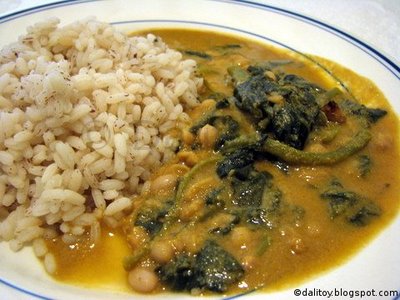
ChaNe Gashi ( Chickpea Curry in Coconut sauce)

Chane Gashi
Chane Gashi or Chickpeas in Coconut sauce is the most delicious konkani curry. The aroma of the chana and the curry leaves just makes the whole meal appetizing. Probably thats the reason why many of them prefer this curry for the festive meals.

Nov 22, 2006

Kuleeth Saaru & Usli (Horsegram soup & Stir fry)

Saaru in Konkani or Kannada is a general name for any thin flavored liquid that has to be eaten with rice. Saaru can also be savoured like a soup. Konkanis do often use the liquid from boiling any grains/legumes for making saaru.

Kuleeth Saaru served
Kuleeth Saaru Served with rice


Kuleeth/Kulthi or Horsegram is a brown flat legume. I had written more about Kuleeth in the past along with Kuleeth Dosa.

Kuleeth is cooked with lots of water, the liquid is separated and used to make saaru. The cooked kuleeth grains is used to make Kuleeth Usli, a side dish that can be eatedn along with chapathi or rice or just like a snack.

1 cup kuleeth
6-7 cloves garlic
2 green chillies
2 dry red chillies

Cook kuleeth in a pressure cooker for about 5 whistles. Drain the liquid from the kuleeth to a sauce pan. Add slit green chillies and salt and bring it to a boil. Keep boiling till the green chillies impart hotness into the saaru.

For the seasoning, roast garlic in a tsp of oil, fry broken red chillies and add to the saaru.
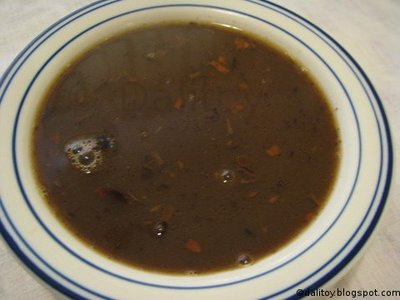
Kuleeth saru
Kuleeth Saaru

Serve with rice or drink like a soup.

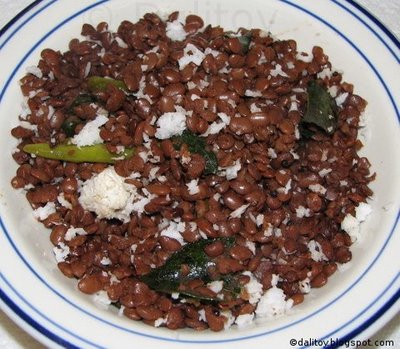
Kuleeth Usli
Make kuleeth usli or a stir fry snack with the cooked grains.
1 cup cooked kuleeth
2 green chillies
1 sprig curry leaves
1/2 tsp mustard
hing
1 tbsp shredded coconut, optional

Heat 1 tsp oil in a kadai/wok. Splutter mustard seeds, add slit green chillies, curry leaves. Add cooked kuleeth, salt and a little water. Cook till all the water evaporates. Garnish with coconut.

Kuleeth Usli
Kuleeth Usli


Serve as a side dish or breakfast or snack.

Nov 9, 2006

White bean and Malabaar Spinach in coconut sauce (tingaLavare bendi )

Konkanis love tingaLavare. TingaLavare or white beans is the most commonly used bean in the konkani cuisine. In this recipe tingaLavare is paired up with the malabaar spinach and the sauce is ofcourse the konkanas favorite-coconut. I have already said more about malabaar spinach here. If you do not find malabaar spinach, substitute with spinach.

TingaLavare Bendi
TingaLavare bendi served with rice


1/2 cup shredded coconut, fresh or frozen
8 red dry chillies
1/2 inch cube tamarind
6-8 cloves garlic
1 bunch malabaar spinach or spinach
1/4 cup white beans or tingaLavare

Soak tingaLavare overnight or for 8-10 hrs. Discard the soaked water, rinse and drain a couple of times. Pressure cook the beans and set aside.

Wash and rinse spinach, drain the water. Chop and cook with the cooked beans for 5 minutes.

In a tsp of oil roast the red chillies. Grind coconut, tamarind and roasted red chillies to a smooth paste. Add the paste to the cooked beans and spinach, add salt and boil for 5minutes.

Roast garlic in a tsp of oil and season the curry.

Serve with rice.

Nov 5, 2006

Malabaar Spinach Curry ( vaali ambaT)

Vaali

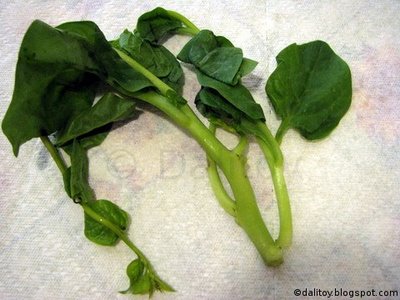
vaaLi in Konkani or basaLe in kannada is a green leafy vegetable available in Mangalore area. Its a kind of spinach but the leaves are thick, succulent and has a tender edible stem. It grows as a creeper, and usually grown on a structure to hold the vine called vaaLi mantap much like how grapes are grown in the vineyards. In Mangalore and surrounding areas they are sold along with the creepers, the leaves and the tender stem is used in the curries while the hard part o f the stem is discarded or planted to grow more.

I did some research on the Internet and found its called by different names - Malabar spinach, Ceylon spinach, saan choy, alogbati, mong toi, Vietnamese spinach. In USA, its available in most of the Chinese/Asian supermarkets under the name mong toi.

vaaLi ambat

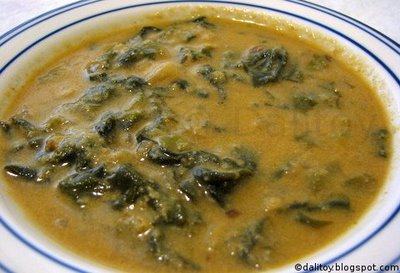
vaaLi ambaT is a curry with coconut gravy with roasted onion seasoning. One of my favorite konkani delicacies.

1 bunch malabaar Spinach/vaaLi.
1/4 cup tuvar Dal
1 cup shredded fresh coconut
6-8 dry red chillies
1/2 inch cube tamarind
1 onion
1 tsp oil

Snip the leaves of vaaLi from the stem. Retain the stem if its tender, discard any hard stem. Wash and rinse, chop the leaves, cut the stem 3 inches long. Set aside. Finely chop half the onion for the seasoning. and the other half a bit bigger.

In a tsp of oil roast the red chillies. Grind coconut, red chillies and tamarind to a smooth paste. The masala or paste is called maasolu in konkani.

Cook tuvar dal in a pressure cooker. Transfer the dal to a sauce pan, add chopped vaaLi, cook for 10minutes till the stems are cooked. Add salt and coconut masala. Chop half the onion and add to the curry. Continue to cook for another 10minutes.

For the seasoning, finely chop the other half of onion. Fry the onions in a tsp of oil under low flame till its completely golden brown. Add to the curry, cover and set aside.

Serve with rice.

The curry can be made with spinach too. Just substitute the vaaLi with spinach. Tastes very similar, one can hardly find out the difference.

Nov 2, 2006

Pomfret ginger onion curry ( Alle piyav gashi)

Alle piyav gashi

Mangaloreans love fish. Sardines/peDvo, Pomfret/maanji, Mackerel/raaju are the mot popular fishes among the konkani's. The konkani fish curries are often made with coconut gravy, that makes it very different from other cuisines. They are a bit hot and savory taste. Alle piyav gashi one of them. In konkani alle means ginger, piyav means onion and gashi is a curry with coconut gravy.

Alle piyav gashi goes well with pomfret or crabs. This time I made it with white promfrets.

2 white pomfrets
1 cup shredded coconut
8 red chillies
1 inch cube tamarind
1 onion
2 green chillies
1/2 inch cube ginger

Clean the pomfrets. Cut of the fins and tail. If you prefer to keep the skull you may retain it. But I discard the head. That's how I was thought to clean the fish by my Mom. Discard the viscera/internal organs. Rinse thoroughly changing the water a few times. Cut the fish across the bones with 1/2- 1 inch width. Set aside

In a tsp of oil, roast the red chillies on low flame. Grind together coconut, tamarind and roasted red chillies to a smooth paste. It is very important to get a smooth paste, do not stop grinding when the coconut is coarse.

Chop onions and ginger finely. Slit green chillies

In a saucepan bring the coconut paste to a boil. Add water and bring it to the desired consistency. You can keep it to the consistency of the Dal. But not too thin. Add onions, ginger and green chillies. Boil the sauce for 5 minutes, add salt. Add the fish pieces one by one to the sauce. Cook it on low flame. Cook for about 10 minutes. Adjust salt.

Serve with rice.

Oct 26, 2006

Mangalore Chicken Curry

alt=
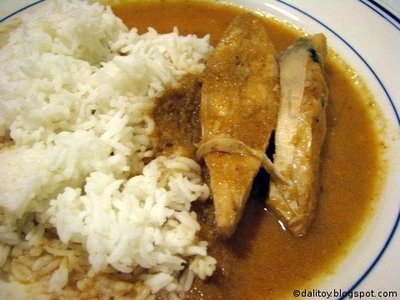
Mangalore Chicken Curry with Parboiled Rice

This is one of the recipes I learnt from my Mother-in-law. She got this recipe many years back from a friend in Mangalore. This curry has no garam masala or any strong pungent flavor. The spicy and savory taste comes from freshly roasted spices and the coconut.

Here is the ingredient list
1/2 kg chicken, preferably with bones
3 medium sized onions
1/2 tsp jeera
1 coconut, shredded
3tsp oil

Ingredients for the Masala
8-12 Hot red chillies
3 tsp coriander seeds
1/2 tsp jeera
1/4 tsp mustard seeds
5 cloves garlic
1/4 tsp turmeric
10 seeds of methi
6 peppercorns

Roast the ingredients listed for the masala in a tsp of oil. Let it cool. Grind into a smooth paste. Now chop 1 onion and grind along with the spices to a paste. Set aside.

Grind the shredded coconut and 1/2 tsp jeera into a smooth paste and keep set aside.

Remove the skin from the chicken pieces and discard the skin. Clean the chicken and keep it ready. In a saucepan add chicken, water and the ground spices and salt. Chop another onion and add to the chicken. Bring it to a boil, cover and cook on allow flame for 20 minutes.Add the coconut paste to the chicken and simmer for another 10 minutes.

Chop the remaining 1 onion finely, fry it in 1 tsp oil until golden brown and add to the chicken.

Serve with rice.

Oct 23, 2006

Rasam

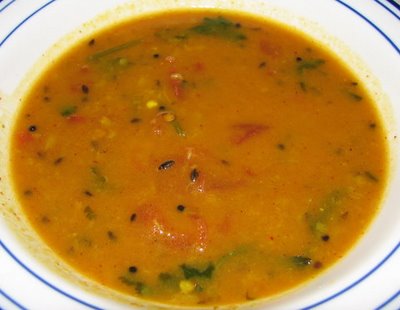
Tomato Rasam

My mother-in-law makes different kinds of rasams. The following is a recipe for dal rasam with tomatoes. You can make rasam with only tamarind, only tomatoes or using both. In the same recipe if you skip tuvar dal, it becomes tomato saaru.

1/4 cup tuvar dal
2 ripe tomatoes
2 tsp rasam powder
2 green chillies
1 tsp jaggery, optional
4 sprigs cilantro/coriander leaves, optional
1/2 inch cube tamarind, optional

for seasoning
1 sprig curry leaves
1/4 tsp mustard seeds
1/4 tsp jeera
1 clove garlic, optional

Cook tuvar dal in a pressure cooker. Transfer the ingredients to a sauce pan. Chop tomatoes; Slit green chillies and add to the dal. Add salt, Bring it to a boil. Stir in the rasam powder, tamarind pulp and jaggery. Keep boiling until the tomatoes and cooked. Add chopped cilantro.

Heat oil in a kadai, splutter mustard seeds and jeera. Add finely chopped garlic fry till its golden brown, add curry leaves. Add the seasoning to the rasam.

Use any leftovers to make Vegetable Soup

Oct 18, 2006

Dal

My mom cooks only Konkani cuisine. Hence Dalitoy was the only Dal I knew until I started eating out. I tried making varieties of North Indian or Punjabi dals but I haven't mastered any so far. This is a version of Dal I learnt from a good friend of mine, Seema. The garlic and hing in this Dal takes all the credit for the taste.
Dal

1 cup tuvar dal
1/4 tsp turmeric
4 green chilies
1 sprig curry leaves
1/4 tsp mustard seeds
1/4 tsp jeera
4 cloves garlic
4-5 sprig cilantro/coriander leaves
pinch of hing powder

Cook tuvar dal in a pressure cooker, see to it that the dal does not get mashed. Transfer the cooked dal to a sauce pan, add turmeric and salt. Add water and bring to the desired consistency. Bring to a boil.

Finely chop green chilies, garlic and cilantro. For the seasoning, heat 2 tsp of oil, splutter mustard seeds, jeera. Add green chilies and fry until it is cooked. Add garlic and fry until it is golden brown. Add curry leaves and stir. Add hing powder to the oil, fry till its aromatic. Add it to the dal.

Garnish with chopped cilantro/coriander leaves.

Serve with plain rice, Ghee Rice or Jeera rice

Make a vegetable soup out of any leftovers

Oct 17, 2006

Bean Soup (Sarupkari)

Sarupkari is a kind of dal made by the konkani people. Unlike other dals, dried beans are used here rather than the dals/lentils. The name sarupkari comes from saaru i.e the liquid dish and and upkari i.e palya/stir fry. So sarupkari is two in one. One can make sarupkari out of any kind of dried beans.

I often make with black beans, rajma, red beans, kidney beans, white beans, whole tuvar or togari in kannada, black eyed peas or green beans/mung beans.

Black Eyed Peas Sarupkari
Black eyed peas Sarupkari


3/4 cups any dried beans of your choice
1 potato, optional
7-8 cloves of garlic
3-4 dried red chilies
2 green chillies, optional

Soak beans overnight or for 12 hrs. It is very important to soak beans. It cooks faster, becomes more tastier and also soaking removes flatulence from the beans. Rinse the soaked beans in water 2 times and drain. Add enough water so that beans are covered. Add diced potatoes. Cook the beans in a pressure cooker. Cook until the beans are well cooked. Its better if the beans are broken and looks a little mashed. This brings some thickness to the sauce. Now transfer the cooked beans to a sauce pan, add salt and slit green chilies. Boil for 5 minutes.

For the seasoning heat a tsp of oil, fry crushed garlic cloves until golden brown. Switch off the flame and add broken red chilies. Fry for a minute and add to the beans. Bring it to a boil and switch off the flame and cover the pot.

Serve with rice.

If you do not develop a taste for the sarupkari with rice, you can simply savor on the sarupakri like a bean soup.

Make a Vegetable Soup out of any leftovers

Oct 11, 2006

KoLambo (Sambar)

sambar
Every household in South India has its version of Sambar. The Sambar in the Fast food Darshinis of Bangalore greatly differs from the Sambar in Chennai. My version of sambar called koLambo(konkani name)is made in the Konkani households in Mangalore. It tastes more closer to the Chennai Sambar.

Most of the households make Sambar powder in a large volume and store. But in the konkani households Sambar is made from the scratch each time by frying spices in oil. Believe me, its not tough to make it from the scratch every time. You get a yummy Sambar.

Here is how I learnt to make Sambar from my Mom.

Here is the ingredients list
2 cups of Mixed vegetables of your choice. Below is the list if veggies I usually use
6-7 Drumsticks pieces(not chicken drumsticks!)
1 Potato
1 Egg plant
1 Carrot
10-12 French beans
1/2 Onions
6-7 Cauliflower florets
2 Tomatoes- this is a must

Spices for Sambar Masala
2 tsp urad dal
1 tsp corainder seeds
1/2 tsp Jeera
1/8 tsp or a pinch of methi seeds
4-5 peppercorns
1/2 inch turmeric root or 1/8 tsp turmeric powder
5 hot red chillies
2 mild byadagi chillies, optional- this gives dark red colour
1 chick pea sized hing

For seasoning
1 tsp mustard seeds
1 sprig curry leaves
2 tbsp chopped cilantro, optional

Cook 1/2 cup tuvar dal in the pressure cooker.
Soak 1 inch cube size tamarind in water.

Make the Sambar masala by roasting spices in oil.
Heat 2 tsp of oil in a round bottomed kadai. You can use the small wok or your seasoning pan/spoon. Add urad dal and fry, when it gets light golden brown add coriander seeds. Fry for a minute, when it gets little darker add jeera, methi, peppercorns and turmeric. Fry for 30 seconds, switch off the flame. Add red chillies and hing, keep frying for a minute. Let it cool.

Grind the roasted spices along with tamarind into a smooth paste.

Chop a variety of vegetables of your choice. I always use tomato. Tomato gives a good taste, helps to bring out the sour-tangy taste in the Sambar. Cook the vegetables in water except cauliflower. Cauliflower takes less time to cook, so add it at the end. When the vegetables are tender add cooked dal and the sambar paste. Add salt. Bring it to a boil. If you are using cauliflower add them now.Continue boiling for another 3-5 minutes.

Make a seasoning of mustard seeds and curry leaves and add to the Sambar. Sprinkle cilantro on top.

Serve with plain rice or Idli

Oct 7, 2006

Konkani Dal (daLitoy)

Konkani Dal

Dalitoy is a konkani daal. No konkani meal is complete without Dalitoy. Its been hailed as the Kuladeva of The Konkanis. The best Dalitoy comes from the Gowda Saraswat Brahmin or the konkani temples surrounding Mangalore. The meals are fed on the banana leaves and the devotees savour on just the Dalitoy.

1 cup Tuvar Dal
4 green chilies
4 red chilies
1 tsp mustard seeds
1 sprig curry leaves
chick pea sized hing
salt to taste

Boil Tuvar Dal in a pressure cooker. Do not worry if the dal gets mashed totally. Transfer the cooked dal to a sauce pan and Bring it to a boil. Add slit green chilies and salt. Keep it on low flame, Let it boil till the hotness of the chilies is tasted in the dal. Taste the dal and adjust salt. For the seasoning, heat 1 tsp of oil, add mustard seeds. When the splutter, Switch of the flame, immediately add broken red chilies and curry leaves. Let the curry leaves impart the flavor in the oil. Take care not to burn the red chilies. Add it to the boiling dal. You can pour a spoonful of dal to the pan that contained the seasoning and add it again to the saucepan, thereby cleaning the seasoning pan. This makes a huge sizzle, so be careful . Dissolve hing in a tsp of water and add it to the dal.

Do not add hing to the seasoning. Do not add cilantro/coriander leaves either. The traditional konkani Dal, daLitoy does not have cilantro or turmeric in it.

Dalitoy can be thick or thin. Each of it has a huge fan base and konkani people often enjoy debating how the dalitoy should be made. The consistency of the dal is purely your choice. Thick Dalitoy is called daaT daaLitoy in konkani which abbreviated as D.D.T for fun.